Scrollytelling design space
Design Space
A visual atlas for the thesis-backed patterns inside scrollytale-starter.
Advanced/internal page. For everyday authoring, start with story-format.md. This page helps the runtime and AI reason about stories more deeply.
Overview
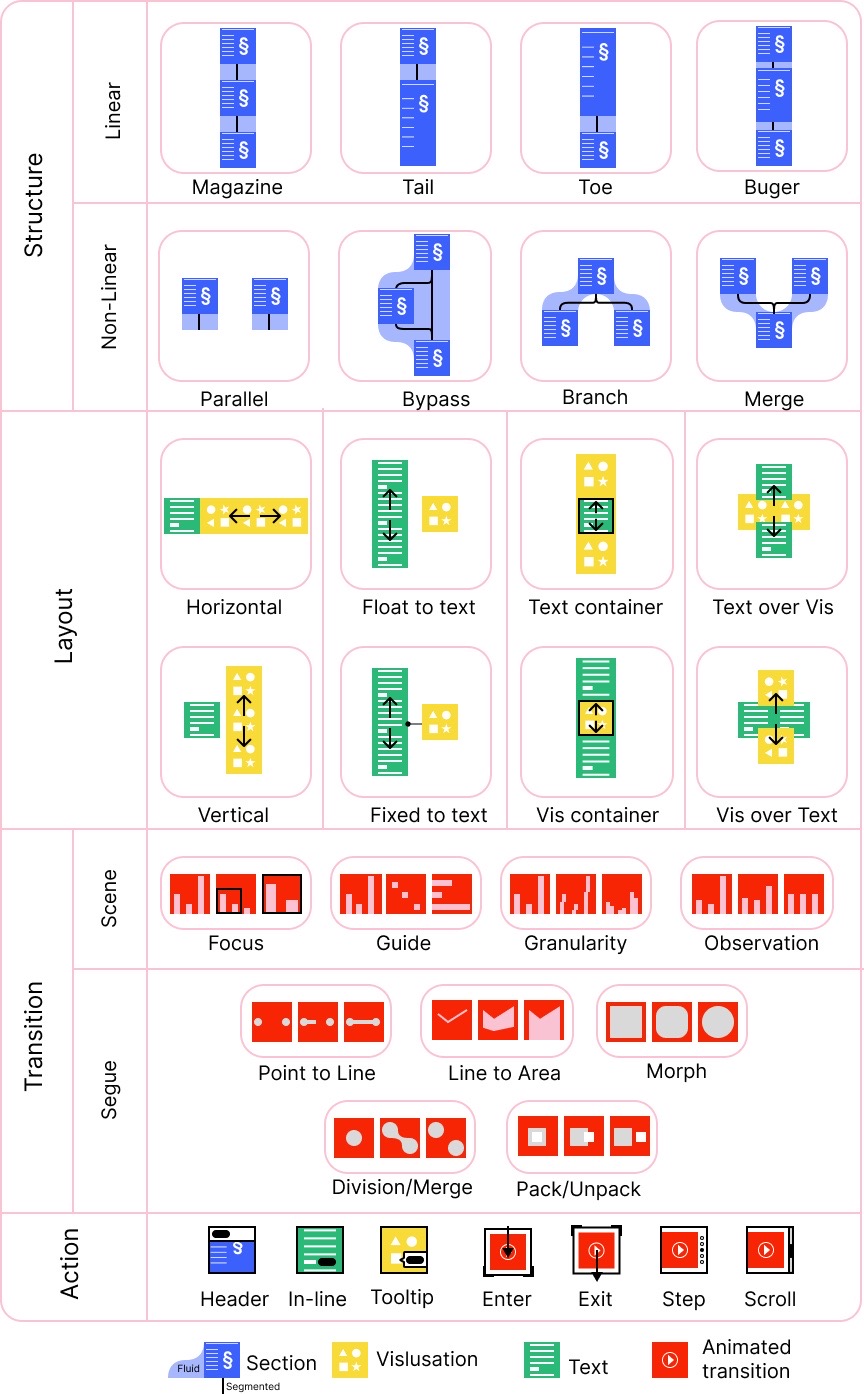
The source vocabulary comes from the thesis chapter on the scrollytelling design space and is organized into four dimensions:
StructureLayoutTransitionAction
The copied icons live at:
public/design-space/icons/docs/public/design-space/icons/
The runtime taxonomy lives in src/runtime/designSpace.js.
Why this page exists
To keep the academic model inside the starter without forcing ordinary authors to learn the whole taxonomy first.
What it powers
Docs, icon assets, normalized story metadata, AI prompting, and future runtime planning.
How It Maps To story.md
The starter keeps the same Markdown-first authoring model, but it now accepts richer design-space metadata.
Global Structure
You can still use the simple form:
structure: linearYou can also use the richer academic form:
structure:
  family: linear
  pattern: burger
Today the runtime still renders a linear DOM flow, but the extra pattern metadata is preserved for planning, AI prompting, and future runtime features.
Section Layout
You can still use the simple preset:
layout: scrolly-rightYou can also attach design-space fields:
layout:
  preset: scrolly-right
  axis: vertical
  binding: float-to-text
  container: vis-container
This lets story.md describe both the starter preset and the academic layout language at the same time.
Scene, Segue, and Action
The thesis transition and action language now maps like this:
scene:focus,guide,granularity,observationtransition.segue:point-to-line,line-to-area,morph,division-merge,pack-unpackaction.trigger:enter,exit,step,scrollaction.affordance:header,in-line,tooltip
Example:
---
title: "Rental pressure across Melbourne"
structure:
  family: linear
  pattern: burger
data:
  sources:
    - id: rents
      path: ./data/rents.csv
---

---
id: widening-gap
layout:
  preset: scrolly-right
  axis: vertical
  binding: float-to-text
  container: vis-container
scene: granularity
transition:
  type: step
  segue: morph
action:
  trigger: step
  affordance:
    - tooltip
---

## The gap becomes visible at suburb level

::vis{type="line" data="rents" x="year" y="value" series="region"}
::

::step
The metro average hides the largest gaps.
::

::step
At suburb level, the spread becomes much wider.
::
Current Support Matrix
This page distinguishes three levels:
- Supported: runtime behavior exists now
- : accepted and normalized, but not yet rendered as first-class behavior
- Still developing: not yet implemented in the runtime
Still Developing Highlights
 Header navigation
Still developingNeeded for non-linear story entry points and chapter jumps.
 Tooltip system
Still developingBest implemented as a shared runtime component instead of one-off chart code.
 In-line controls
Still developingUseful for lightweight toggles and local exploration inside narrative paragraphs.
 Segue transitions
Still developing`morph`, `point-to-line`, and `pack-unpack` still need reusable visual transition primitives.
Structure
| Pattern | Status | Notes |
|---|---|---|
linear | supported | Default starter flow |
parallel, bypass, branch, merge | metadata | Useful for authoring plans and future navigation work |
Layout
| Preset / Pattern | Status | Notes |
|---|---|---|
chapter | supported | Default Markdown-first narrative section |
hero | supported | Approximates an editorial opening |
scrolly-left | supported | Sticky figure + text steps |
scrolly-right | supported | Sticky figure + text steps |
full-width | supported | Flow section without sticky scrolly |
scrolly-overlay | supported | First-class overlay layout for text-over-vis scrolly sections |
axis, binding, container, overlap metadata | metadata | Stored in normalized story objects |
Transition
| Pattern | Status | Notes |
|---|---|---|
 focus | supported | Scene label available now |
 guide | supported | Scene label available now |
 granularity | metadata | Accepted in syntax and normalization |
 observation | supported | Scene label available now |
 point-to-line | metadata | Needs reusable vis transition primitives |
 line-to-area | metadata | Same as above |
morph | metadata | Same as above |
 division-merge | metadata | Same as above |
 pack-unpack | metadata | Same as above |
Action
| Pattern | Status | Notes |
|---|---|---|
 enter | metadata | Accepted in syntax, lifecycle hooks still thin |
 exit | metadata | Same as above |
 step | supported | Already wired via ::step + Scrollama |
 scroll | supported | Default scrolly motion model |
header | Still developing | Needed for non-linear navigation |
in-line | Still developing | Best added as embedded controls or toggles |
tooltip | Still developing | Good candidate for shared runtime component |
Why This Matters
This gives the project a shared language across:
- thesis writing
- case-study analysis
story.mdauthoring- AI prompting
- future runtime planning
The starter no longer has to choose between being academic or practical. The design space now acts as a bridge between the two.
Recommended Next Runtime Steps
- Add
scrolly-overlayas the next layout preset. - Turn
transition.segueinto reusable vis controllers instead of metadata only. - Add shared
tooltipandheadercomponents so non-linear structures can become real runtime features.